


How to Deliver Safe Manual Handling Training
- MI Team Training

- Jul 31
- 5 min read
A manual handling session can look successful because everyone has practised a lift. Its real value shows later, when a care worker repositions equipment, a warehouse colleague moves an awkward load, or a school employee sets up a hall under time pressure. Knowing how to deliver safe manual handling means teaching people to make safer decisions in the situations they actually face, not simply asking them to copy a technique.
For employers, effective training supports a safer workplace, helps meet health and safety responsibilities and gives staff the confidence to stop and reassess when a task is unsuitable. It should be practical, relevant and delivered by a suitably qualified trainer who understands both the principles of safe movement and the realities of the working environment.
Start with the job, not the training room
Manual handling includes lifting, lowering, carrying, pushing, pulling, holding and moving loads by bodily force. The load may be a box, a trolley, a delivery, furniture, equipment or, in care settings, a person. Each creates different risks, so a generic demonstration alone cannot cover every task.
Before delivering training, review the workplace manual handling assessment and speak with the people doing the work. Ask what is moved, how often, where the task happens and what makes it difficult. Consider the route, available space, floor condition, storage height, load stability, team working arrangements and whether the work changes during busy periods.
This preparation matters because manual handling risks are rarely caused by weight alone. A light but bulky item can block vision. A manageable box becomes a problem when it must be lifted from floor level, carried through a narrow doorway or moved repeatedly over a shift. In a care environment, the person being assisted may be unable to support their own weight or may become distressed. Training needs to reflect these differences.
Use the hierarchy of control before teaching a lift
The safest manual handling task is often the one that has been reduced, redesigned or removed. Training should never be used as a substitute for sensible planning, suitable equipment and safe systems of work.
Encourage managers and staff to consider whether the task can be avoided, whether the load can be split, and whether a trolley, hoist, height-adjustable surface or different storage arrangement would reduce the risk. A delivery placed at waist height may remove the need for repeated low-level lifting. A suitable trolley may reduce carrying, but it still needs to be appropriate for the load and route.
Where handling cannot be avoided, staff should be taught to pause and assess. A simple prompt is useful: can I manage this safely, is the route clear, do I have the right equipment, and do I need help? This creates a practical habit rather than a rigid rule.
How to deliver safe manual handling in a practical session
A strong session balances clear explanation with enough supervised practice for people to apply the principles. Begin by explaining the risks in plain language. Musculoskeletal injuries can develop gradually through repetition and poor working positions, as well as through one sudden strain. The aim is not to make staff fearful of moving items. It is to help them recognise when a task needs a different approach.
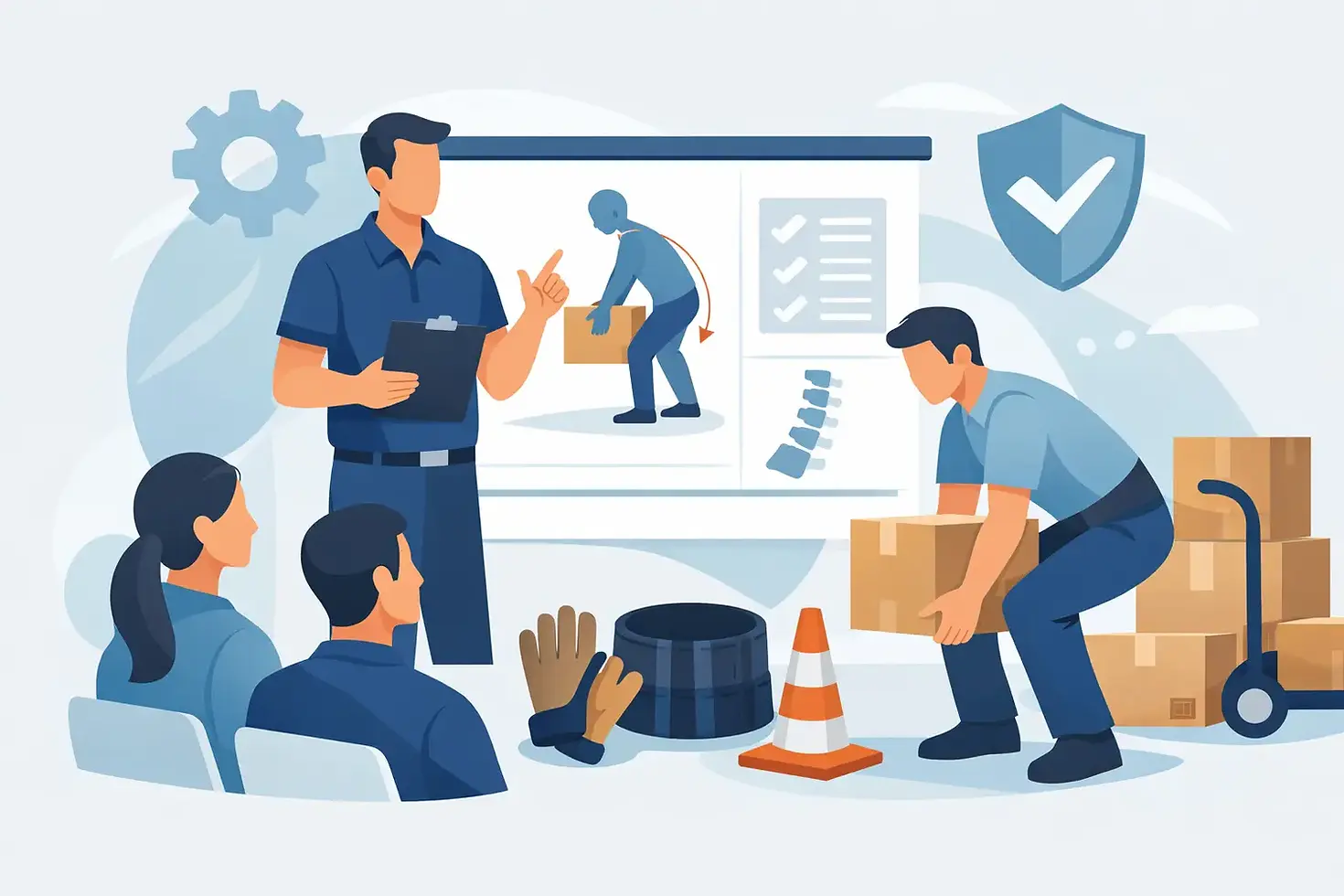
Demonstrate a safe handling process slowly, explaining what you are doing and why. Show how to plan the movement, position the feet for stability, keep the load close where possible, use the legs appropriately, avoid twisting under load and move smoothly. Explain that there is no single, perfect lifting posture for every job. The safest position depends on the task, the individual and the environment.
Then give learners time to practise with representative loads and equipment. This should be closely supervised. Correcting a hand position or rushed turn in the moment is far more useful than leaving people to repeat a risky movement. Use realistic but controlled examples, such as moving archive boxes, loading a trolley, handling a bulky item or working in a restricted space.
Training should also cover tasks that are easily overlooked. Pushing and pulling can place considerable strain on the body, especially when wheels are poorly maintained, floors are uneven or a trolley is overloaded. Repetitive handling, work at low or high levels, and team lifts all deserve attention if they form part of the role.
Teach judgement, not just a sequence of movements
A common mistake is presenting a lifting technique as a guaranteed solution. Even good body mechanics will not make an oversized, unstable or unexpectedly heavy load safe. Learners need permission to stop, seek assistance or use an alternative method.
Build decision-making into the session by asking questions. What would change if the box had no handles? What if the route was wet? What if a colleague was unavailable for a team lift? What if the item needed to be placed above shoulder height? These scenarios help people transfer learning from the training area to their normal working day.
For team handling, make communication explicit. Colleagues should agree the route, destination, grip and commands before moving. One person should coordinate the lift, and everyone should understand that any member of the team can call a stop. Team lifting is not automatically safer: poor coordination can increase the risk.
Make the training suitable for the people attending
Manual handling instruction should be inclusive and proportionate. Consider participants’ experience, job roles, language needs and any health conditions or limitations that may affect practical activity. A private conversation before the session can help identify adjustments without putting anyone on the spot.
Staff should never feel pressured to attempt a practical task that is unsuitable for them. Alternative ways to take part can still allow them to understand the principles and contribute to discussion. Equally, managers should not assume that a fit-looking employee can safely manage every load. Capability varies, and risk assessment must account for the individual as well as the task, load and environment.
In specialist settings, use role-specific content. Care staff may need training aligned with agreed moving and assisting plans, equipment and local procedures. School teams may handle tables, sports equipment, deliveries and display materials. Warehouse staff may face repetitive handling, pallet movements and loading areas. The principles remain similar, but the examples and controls should match the work.
Check understanding through observation
A certificate confirms attendance and assessment against the course requirements. It does not, on its own, prove that safer practice will continue in every workplace situation. Build in opportunities to observe learners and ask them to explain their decisions.
During practical activities, look for whether participants plan the route, test the load where appropriate, position themselves safely and avoid unnecessary reaching or twisting. Ask what they would do differently if the task changed. This reveals understanding more effectively than asking people to repeat a definition.
After training, supervisors have an important role. They should reinforce safe systems of work, act on reported problems and avoid creating pressures that encourage shortcuts. If staff repeatedly struggle with the same task, the answer may be equipment maintenance, changes to storage or staffing arrangements, rather than more reminders about lifting technique.
Keep training current and connected to the workplace
Manual handling training should be reviewed when work activities, equipment, layouts or staff responsibilities change. Refresher training can help reinforce good habits, particularly where tasks are frequent, staff turnover is high or incidents and near misses indicate that controls need attention.
It is also worth recording the issues raised during sessions. Learners often identify practical barriers that managers have not seen, such as a tight turn near a storeroom, a damaged trolley wheel or items routinely stored too high. Acting on these observations shows that training is part of a wider safety culture, not a one-off compliance exercise.
A qualified, engaging trainer can make the session memorable, but the workplace must make safe choices possible afterwards. When people have suitable equipment, realistic time, clear procedures and the confidence to speak up, manual handling training becomes something staff use rather than something they simply complete.


Comments